
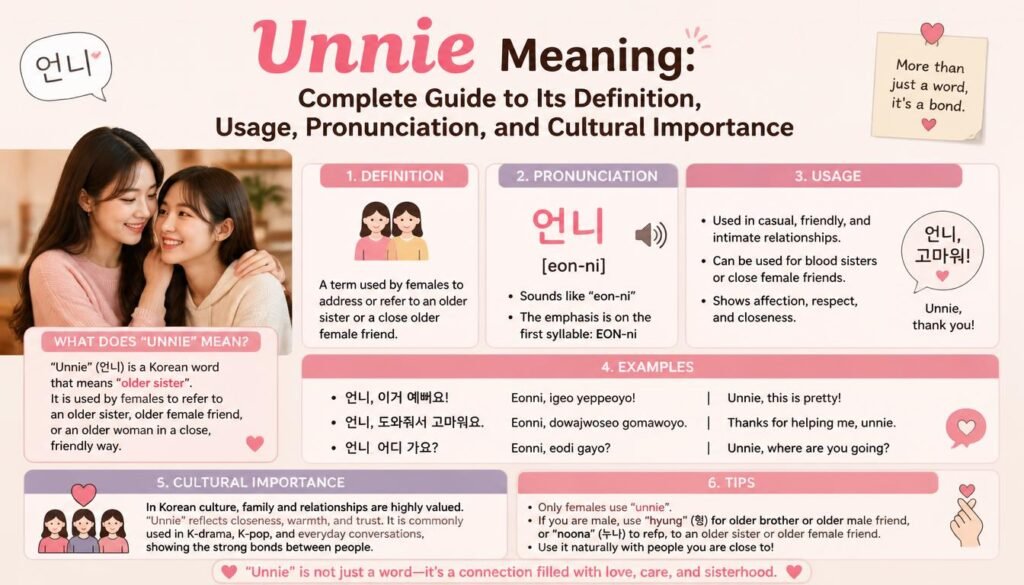
If you enjoy watching Korean dramas or listening to K-pop, you’ve probably heard the word unnie many times. A younger woman might call someone “Unnie!” with a smile, and fans often use the same word when talking about their favourite female idols. It sounds simple, but it actually carries a much deeper meaning in Korean culture. It’s not just another word for “older sister.” There’s a bit more going on than that.
Understanding the Unnie meaning helps you learn not only a Korean word but also how relationships, respect, and social customs work in Korea. Once you know when and how to use it, many conversations in Korean dramas, TV shows, and everyday life start making a lot more sense.
In this guide, you’ll learn what unnie means, who can use it, when it is appropriate, how to pronounce it, and why it has become popular around the world.
What Does Unnie Mean?
The simplest Unnie meaning is:
Unnie (언니) means “older sister” when spoken by a younger female to an older female.
Even though the English translation says “older sister,” the Korean word has a wider meaning. It can be used for a biological sister, but it is also commonly used for close female friends, trusted seniors, mentors, or someone who has a warm relationship with the speaker.
For the word to be used correctly, three things usually apply:
- The speaker is female.
- The person being addressed is female.
- The person being addressed is older than the speaker.
That sounds simple enough, although many beginners mix it up at first.
Quick Definition Table
| Korean Term | Meaning | Used By |
|---|---|---|
| Unnie (언니) | Older sister | Younger female → Older female |
| Oppa (오빠) | Older brother | Younger female → Older male |
| Noona (누나) | Older sister | Younger male → Older female |
| Hyung (형) | Older brother | Younger male → Older male |
These words are all part of the Korean honorific system, where language changes depending on age, relationship, and respect.
How Do You Pronounce Unnie?
Many English speakers write the word as Unnie, but its official Romanization is eonni.
It is written as:
언니
The pronunciation sounds close to:
“uh-nee.”
A simple pronunciation guide looks like this:
| Korean | Romanization | Sound |
|---|---|---|
| 언니 | eonni | uh-nee |
You don’t have to pronounce it perfectly on your first try. Honestly, most international fans learn it naturally after hearing it many times in Korean dramas and songs.
Why Is Unnie Important in Korean Culture?
The Korean language works differently from English.
In English, people often call each other by their first names. In Korea, however, people frequently use relationship titles instead of names. These titles immediately show respect, age, and social connection.
The word Unnie reflects several important cultural values:
- Respect for older people
- Close relationships
- Social identity
- Family-like affection
- Everyday politeness
It’s kinda interesting because one small word tells people quite a lot about the relationship between two individuals.
The Korean Honorific System
The Korean honorific system is one of the most important parts of the language.
Instead of simply saying someone’s name, Korean speakers often choose titles that describe the relationship.
For example:
| Situation | Common Title |
|---|---|
| Student → Teacher | Seonsaengnim |
| Junior → Senior | Sunbaenim |
| Younger woman → Older woman | Unnie |
These relationship titles help conversations sound polite while also showing social awareness.
The Cultural Meaning Behind Unnie
The Unnie meaning goes far beyond “older sister.”
In Korean culture, the word often represents:
- Trust
- Respect
- Warmth
- Affection
- Emotional support
- Friendship
Many Korean women describe an unnie-dongsaeng relationship as something between friendship and family. The older person often gives advice, encouragement, or support, while the younger person shows appreciation and respect.
That’s probably one reason the word feels warm instead of formal.
Age Matters in Korea
Age plays a much bigger role in Korean society than it does in many Western countries.
Even a one-year age difference can influence how people speak to each other.
For example:
A 21-year-old woman speaking to her 24-year-old friend may naturally say:
“Unnie, let’s eat together later.”
The word politely recognises the age difference while keeping the conversation friendly.
Who Can Use the Word Unnie?
Many learners ask this question because they hear the word everywhere.
The answer is actually quite clear.
You can use Unnie if:
- You are female.
- The other person is female.
- She is older than you.
- You have a friendly or comfortable relationship.
If these conditions are met, the word usually sounds natural.
Who Should Not Use Unnie?
Not everyone should use this word.
Generally speaking:
- Men do not call older women Unnie.
- Older women do not call younger women Unnie.
- It should not normally be used in very formal business situations.
Instead, Korean speakers may use titles like:
- Seonsaengnim
- Sunbaenim
- Kim-ssi
- Manager-nim
These titles sound more respectful in professional settings.
Real-Life Situations Where People Say Unnie
One reason this word is so popular is because people use it every single day.
Here are some common situations.
Family
A younger sister may say:
“Unnie, can you help me?”
Here, the meaning is exactly “older sister.”
Friends
Many close female friends use Unnie even when they are not related.
For example:
A university student might call her slightly older friend Unnie because they have become close over time.
University
Junior students often use Unnie when speaking with older female students.
This shows friendliness while also respecting seniority.
Workplace
Some female coworkers also use Unnie if the workplace is relaxed and informal.
Cafés and Small Shops
Sometimes customers casually call slightly older female staff Unnie, although this depends on the situation and the person’s comfort level.
Unnie in Text Messages
The word also appears frequently in Korean texting.
Some common examples include:
- Unnie, what are you doing?
- I miss you, Unnie.
- Unnieee!
- 언니ㅎㅎ
Adding extra letters or playful expressions makes the message sound more friendly and affectionate.
You’ll notice this style a lot in Korean fan communities and social media conversations.
Why K-Pop Fans Say Unnie
International fans often hear the word while watching K-pop content.
Female fans sometimes call female idols Unnie because they admire them and feel emotionally connected to them.
For example:
“Jennie Unnie is amazing.”
The fan obviously isn’t related to Jennie. Instead, the word expresses admiration and closeness.
This usage has become common across:
- Fan communities
- Live streams
- Fan chats
Thanks to K-pop and Korean entertainment, millions of people now recognise the Unnie meaning even if they have never studied Korean.
Unnie in Korean Dramas
Korean dramas have introduced countless international viewers to this word.
Characters often use Unnie during emotional scenes, everyday conversations, funny moments, and family discussions.
You may hear lines like:
“Unnie, wait for me!”
or
“Unnie, don’t leave!”
Because dramas repeat the word naturally, viewers slowly understand how important relationship titles are in Korean communication. It’s almost impossible to watch several dramas without hearing it dozens of times.
Unnie vs Noona
People often confuse these two words.
The difference is actually very easy.
| Word | Used By | Refers To |
|---|---|---|
| Unnie | Female | Older female |
| Noona | Male | Older female |
Both words mean “older sister,” but the speaker’s gender changes which one should be used.
Unnie vs Oppa
Another common comparison is Unnie vs Oppa.
| Word | Meaning |
|---|---|
| Unnie | Older female addressed by a younger female |
| Oppa | Older male addressed by a younger female |
Many beginners accidentally use Oppa for women, which can sound quite confusing to native Korean speakers.
Common Mistakes People Make
Many Korean learners make small mistakes when using relationship titles.
Here are the most common ones.
Thinking Unnie Means Best Friend
It doesn’t.
A best friend may be called Unnie, but only if the age and relationship fit.
Men Saying Unnie
Men normally use Noona instead.
Calling Every Older Woman Unnie
Not every older woman should automatically be called Unnie.
The relationship needs some familiarity.
Using It in Formal Meetings
Formal situations usually require professional titles rather than casual relationship terms.
Simple Checklist
Before using Unnie, ask yourself these questions:
- Are you female?
- Is she older than you?
- Do you know her well enough?
If you answered yes to all three, then Unnie is probably the right choice.