
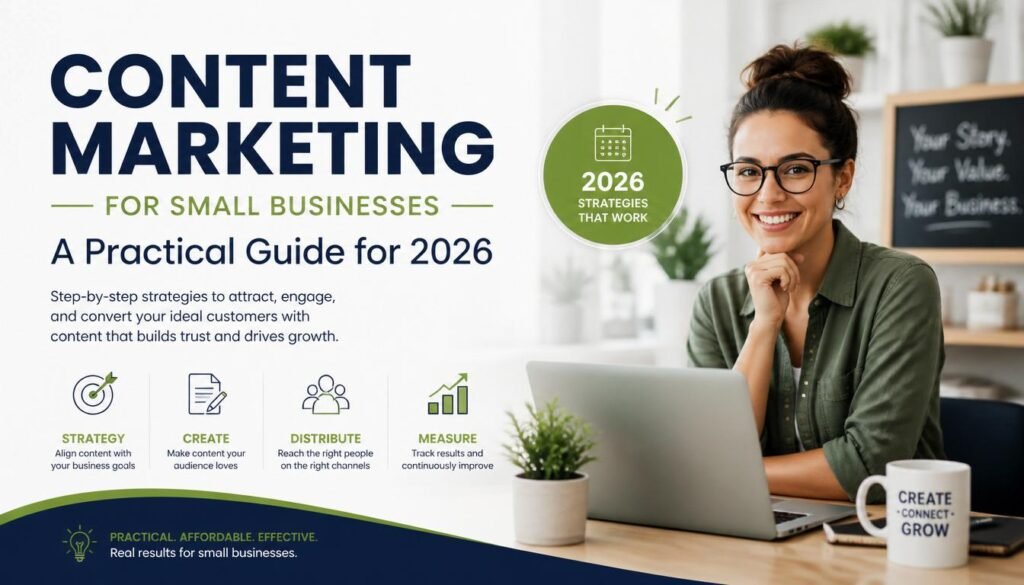
If you run a small business, you have probably heard someone tell you that “content is king” so many times that the phrase has basically lost all meaning. It sounds like the kind of thing a marketing consultant says right before handing you an invoice. But underneath the cliché there is something real going on, and the data backs it up in a way that is hard to dismiss. Small businesses that commit to content marketing are consistently outperforming those that treat it as an afterthought, and the gap between the two groups is widening every year as search engines and AI tools reward genuine expertise over thin, generic pages.
This guide is meant to be the resource I wish existed when I first started paying attention to content marketing for small businesses. Not a listicle of “50 content marketing tips,” but a straightforward walkthrough of what content marketing actually is, why it works, what it costs, and how to build a plan you can realistically stick to without a marketing department behind you.
What Content Marketing Actually Means for a Small Business
Content marketing, at its core, is the practice of creating and sharing useful, relevant material — blog posts, videos, guides, social posts, email newsletters — with the goal of attracting and keeping a clearly defined audience. Unlike traditional advertising, where you’re paying to interrupt someone, content marketing works by earning attention. You give people something worth their time, and in exchange they come to trust your business enough to eventually buy from you.
For a small business owner, this distinction actually matters a lot, mostly because of budget. Paid advertising is a rented audience; the moment you stop paying, the traffic stops too. Content, once published and indexed, keeps working for months or even years. A blog post you wrote in January can still be pulling in leads the following December, something that simply cannot be said for a Google Ads campaign.
There is also a strategy dimension small businesses tend to overlook. <cite index=”5-1″>Roughly seventy percent of B2C marketers and seventy-three percent of B2B marketers now operate with a documented content marketing strategy, and companies with a written plan generate about three times as many leads per dollar spent compared to those improvising as they go.</cite> Having a plan on paper, even a simple one, is itself a competitive advantage.
Why Content Marketing Works So Well for Small Businesses
Here’s the part that surprises a lot of owners: content marketing doesn’t just work for small businesses, it tends to work better for them, proportionally, than it does for large enterprises. There’s a fairly intuitive reason for this. Small businesses usually have deep, specific expertise in a narrow niche, and search engines have gotten increasingly good at rewarding that kind of specificity over generic corporate copy.
A few figures make the case clearly.
| Metric | Data Point |
|---|---|
| Small business ROI advantage on blogging | <cite index=”6-1″>Small businesses are 23% more likely than average companies to see ROI from blog posts</cite> |
| Lead generation from active blogs | <cite index=”6-1″>Companies with active blogs generate roughly 67% more monthly leads than those without one</cite> |
| Website traffic impact | <cite index=”6-1″>Businesses that publish consistently see about 55% more website visitors than non-blogging competitors</cite> |
| Indexed pages | <cite index=”6-1″>Blogging websites end up with around 434% more indexed pages, which directly expands their organic search footprint</cite> |
| Publishing frequency payoff | <cite index=”6-1″>Companies publishing eleven or more posts a month see five times more leads than those posting once a week or less</cite> |
None of this means you need to publish daily starting tomorrow. It means consistency compounds, and even a modest, sustainable rhythm beats sporadic bursts followed by long silences.
There’s also a cost angle that’s easy to underestimate. <cite index=”7-1″>Content marketing generates roughly three times more leads than outbound marketing while costing about sixty-two percent less</cite>, which for a business watching every dollar is not a small consideration. And when it comes to actual return, <cite index=”4-1″>the average return on content marketing spend has landed around $7.65 for every dollar invested</cite>, a figure that most paid channels simply cannot match once you account for the ongoing spend required to keep ads running.
Building a Content Marketing Strategy From Scratch
Most guides jump straight to “write blog posts” without addressing the groundwork, and that’s how a lot of small businesses end up with a blog full of posts nobody reads. Before you write a single word, there are three things worth nailing down.
Define Your Audience Properly
Not “small business owners,” not “everyone who might need my product.” Get specific. What is the exact problem this person is trying to solve at 11pm when they open Google? A plumber’s ideal reader searching “why is my water heater making noise” is in a completely different mindset than someone searching “best water heater brands 2026,” and your content needs to speak to each of those intents differently.
A useful exercise is writing down the actual questions your customers ask you in person, on the phone, or in emails. Those questions are usually a goldmine of blog topics because they represent real, unscripted demand rather than guesses.
Set Goals That Aren’t Just “More Traffic”
Traffic is a vanity metric if it doesn’t lead anywhere. <cite index=”9-1″>Only about 41% of marketing teams now measure content success through direct sales rather than traffic or engagement alone</cite>, and that shift matters because it forces you to connect content back to revenue. Decide upfront whether a given piece of content exists to generate leads, build email subscribers, support a sales conversation, or simply establish authority for a topic you want to rank for long term. Different goals call for different formats and different calls to action.
Choose Formats You Can Actually Sustain
This is where a lot of small businesses trip up. They watch a webinar about video marketing, get excited, and commit to a format that’s completely unsustainable given their time and resources. Better to pick one or two formats you can maintain consistently than five formats you abandon after a month.
That said, format does matter. <cite index=”1-1″>Blogs remain a core channel, used by about 79% of content marketers, while video has become close to indispensable, with 87% of marketers noting it boosts traffic and 38% calling it their highest-performing format overall.</cite> If you have the resources, pairing a blog post with a short video covering the same topic tends to outperform either format alone, since it captures people who prefer to watch rather than read.
Blogging Still Works — Here’s the Actual Data
There’s a persistent myth that blogging is dead, usually repeated by people who tried it for six weeks, didn’t see results, and gave up. The data tells a very different story, especially for small businesses with a defined niche.
<cite index=”7-1″>More than 600 million blogs exist worldwide, and roughly 7.5 million new blog posts get published every single day.</cite> That sounds discouraging until you realize most of those posts are thin, poorly researched, or written purely to hit a word count — which is exactly the gap a genuinely well-researched, specific post can fill. Competing on volume is a losing game for a small business; competing on depth and specificity is winnable.
And people are still reading. <cite index=”7-1″>Around 83% of internet users, roughly 4.44 billion people, read blog content regularly</cite>, which is a large enough audience that even capturing a tiny sliver of it in your specific niche can meaningfully move a small business’s revenue.
A few practical blogging habits that tend to separate winners from the pack:
- Answer one specific question per post rather than trying to cover an entire topic broadly
- Update older posts every six to twelve months instead of only publishing new ones
- Link related posts to each other so readers (and search engines) can see the full picture of your expertise
- Include real numbers, examples, or case studies from your own business rather than generic advice
- Write headlines that match how people actually search, not clever wordplay that sounds good but nobody types into Google
Budgeting for Content Marketing as a Small Business
Owners always ask the same question eventually: how much should this actually cost? The honest answer is “it depends,” but there are useful benchmarks to anchor around rather than guessing blindly.
<cite index=”4-1″>The U.S. Small Business Administration generally recommends that businesses with under five million dollars in annual revenue allocate somewhere around seven to eight percent of gross revenue to marketing overall</cite>, with content marketing typically representing a meaningful slice of that total rather than the whole thing. A rough allocation that tends to work reasonably well within a broader marketing budget looks something like this.
| Channel | Suggested Share of Marketing Budget |
|---|---|
| Content marketing (SEO-focused) | 25–30% |
| Email marketing | 15–20% |
| Paid search | 10–15% |
| Paid social media | 10–15% |
| Video production | 10–12% |
| Marketing technology and AI tools | 8–10% |
| Influencer or partnership work | 5–8% |
Source: <cite index=”4-1″>budget framework based on Almcorp’s 2026 recommendations</cite>
Startups or businesses in aggressive growth mode should expect to spend meaningfully more, sometimes well above this range, since building a content library and audience from zero takes more upfront investment than maintaining one that already exists.
One more number worth sitting with: <cite index=”8-1″>there were roughly 34.75 million small businesses operating in the United States as of 2024, accounting for about 99.9% of all U.S. firms</cite>. That’s a staggering amount of competition for attention, which is exactly why a documented, consistent content strategy stops being optional and starts being the thing that determines whether your business gets found online at all.
The Role of AI in Small Business Content Marketing
It would be dishonest to write a content marketing guide in 2026 and skip AI, because it has genuinely changed how small businesses operate in this space, mostly for the better if used carefully. <cite index=”10-1″>Around 67% of small businesses now use AI for content creation and SEO work, and 71% of marketers report meaningful productivity gains, saving an average of over 11 hours per week on routine tasks.</cite>
The important nuance here, and one that’s easy to miss, is the difference between simply using AI and strategically adopting it. <cite index=”2-1″>Businesses report better marketing ROI specifically when they restructure their workflows around AI rather than just running existing tasks through a tool</cite> — meaning the value comes from freeing up time for strategic thinking, authentic brand voice, and real customer relationships, not from mass-producing generic articles nobody asked for. AI content that reads like it was generated in thirty seconds and never touched by a human tends to underperform, sometimes badly, compared to content where AI handled research and drafting but a real person shaped the final voice and added genuine expertise.
<cite index=”10-1″>The AI marketing technology sector itself grew from about $15.8 billion in 2021 to roughly $107.5 billion in 2025</cite>, which gives you a sense of just how quickly the tooling around this has matured. For a small business, that means better, cheaper tools are becoming available constantly, but it also means the bar for “acceptable” content quality keeps rising, since competitors have access to the same tools.
Common Mistakes Small Businesses Make With Content Marketing
Having looked at a lot of small business blogs and content calendars over the years, the same handful of mistakes show up again and again.
- Publishing inconsistently. One post in March, nothing until August, then three posts in a week. Search engines and readers both reward consistency, even a modest one-post-a-month rhythm, over sporadic bursts.
- Writing for search engines instead of people. Keyword-stuffed, robotic copy might have worked a decade ago; it doesn’t anymore, and modern search algorithms are specifically built to penalize it.
- Never updating old content. A post from 2022 with outdated statistics and broken links is actively hurting your credibility, not just sitting there neutrally.
- Skipping distribution. Writing a great post and never sharing it anywhere beyond the blog itself. Email your list, post excerpts on social, mention it in your newsletter.
- No clear next step. A blog post that doesn’t tell the reader what to do next — subscribe, book a call, download a guide — is a missed opportunity, every single time.
- Ignoring the data. <cite index=”9-1″>Enterprise marketers are about twice as likely as small teams to have mature tracking in place</cite>, which means a lot of small businesses are flying blind on what’s actually working, wasting effort on formats or topics that never converted anyone in the first place.
Measuring Content Marketing ROI
Content marketing ROI is trickier to measure than a paid ad’s cost-per-click, mostly because the payoff is delayed and spread across multiple touchpoints. Still, there are a handful of metrics worth tracking from day one rather than trying to retrofit measurement later.
- Organic traffic growth, tracked monthly rather than daily, since day-to-day fluctuation is mostly noise
- Keyword rankings for the specific terms your ideal customer actually searches
- Email subscriber growth attributable to specific pieces of content
- Lead form submissions or booked calls originating from blog or content pages
- Time on page and scroll depth, which hint at whether people are actually reading or bouncing immediately
- Assisted conversions, meaning content that didn’t close the sale directly but appeared somewhere in the customer’s research journey
<cite index=”9-1″>Content marketing tends to generate around six times more conversions than other methods for the same amount of traffic</cite>, which is a strong argument for treating it as a long-term investment rather than judging it against a single month’s numbers.
A Simple 90-Day Content Marketing Plan for Small Businesses
If all of this feels overwhelming, here’s a stripped-down plan that a one-person marketing team, or even a busy owner doing it themselves, can realistically execute.
Days 1–14: List the twenty most common questions your customers actually ask. Pick your five best. Set up basic analytics if you haven’t already.
Days 15–45: Publish one thorough, genuinely useful post per week answering one of those five questions. Share each one on whatever social channel your customers actually use, not every channel that exists.
Days 46–60: Go back and look at what’s getting traffic and what isn’t. Double down on the topics resonating; don’t be precious about the ones that flopped.
Days 61–90: Add one supporting format — a short video, an email series, or a downloadable guide — built around your best-performing post so far. Start tracking leads generated specifically from content, even with a simple spreadsheet.
Ninety days isn’t enough to see the full compounding effect content marketing offers, but it’s enough to build the habit and gather real data about what your specific audience actually responds to.
Final Thoughts
Content marketing for small businesses isn’t a trick or a shortcut, and honestly, anyone promising overnight results is selling something. It’s closer to compound interest: small, consistent deposits of genuinely useful content that add up to something substantial over time, usually well before your competitors who are still debating whether it’s “worth it” have gotten started.
The businesses winning at this in 2026 aren’t necessarily the ones with the biggest budgets. They’re the ones being specific, staying consistent, and actually answering the questions their customers are asking, rather than publishing generic content because a checklist told them to. That’s genuinely good news for a small business, because specificity and consistency are things you can control regardless of how big your marketing budget is.