
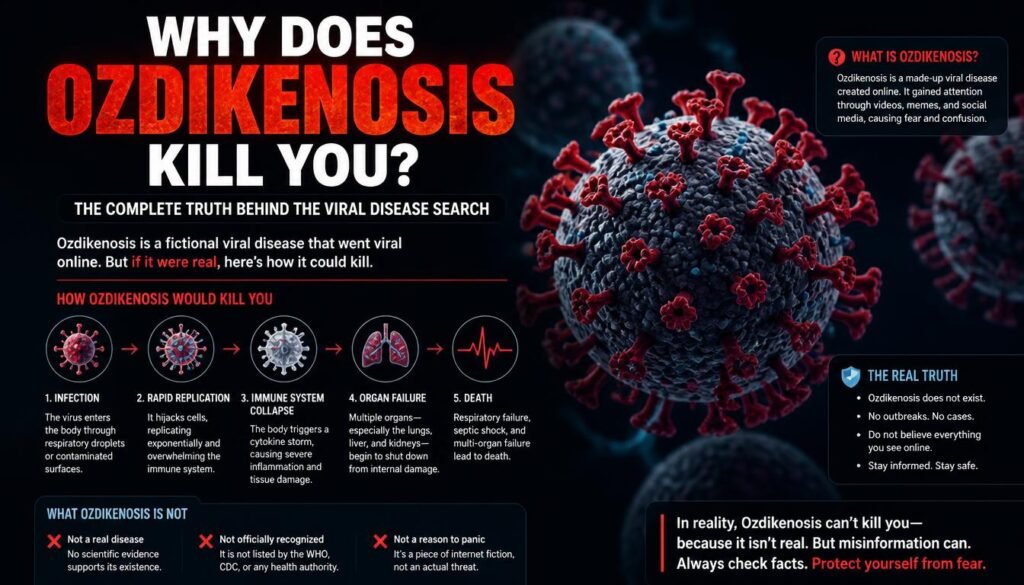
You typed it into Google at 1am, didn’t you. “Why does ozdikenosis kill you.” Maybe you saw it on a TikTok caption, maybe a friend sent you a screenshot with three exclamation points, maybe it just showed up in your search suggestions and your stomach dropped a little. That reaction makes sense. The phrasing is built to trigger it.
Here’s the short version, and I’m putting it right up top because you deserve the answer before the explanation: ozdikenosis is not a real disease. It does not appear in any medical database, it has never been diagnosed in a hospital, and no peer-reviewed journal has ever described it. So the honest answer to “why does ozdikenosis kill you” is that it doesn’t, because there is no it to do the killing.
But that answer alone won’t stop the searches, because the internet doesn’t really run on facts, it runs on curiosity loops. So let’s actually dig into where this thing came from, why your brain wants to believe it, and how to spot the next fake disease before it gets you scrolling at midnight again.
Is Ozdikenosis a Real Disease?
No. Flatly, no. And this isn’t a judgment call or a gray area — it’s checkable in about ninety seconds.
Real diseases live in specific places. They show up in the World Health Organization’s ICD classification system, they get case studies published in journals like The Lancet or NEJM, and they have treatment protocols that doctors actually follow. Ozdikenosis has none of that. Zero entries, zero citations, zero clinical history.
Here’s what a quick verification actually looks like:
| Verification Source | Ozdikenosis Listed? | What This Tells Us |
|---|---|---|
| WHO ICD Database | No | Not recognized as a diagnosable condition anywhere |
| CDC Disease Index | No | No U.S. public health tracking exists |
| PubMed / peer-reviewed journals | No | Zero clinical research or case studies |
| Hospital diagnostic systems | No | Not a billing code, not a chart entry, nothing |
You can go check this yourself, and honestly you should, because that habit will save you a lot of anxiety down the line. The WHO’s classification standards are public at who.int, and CDC’s disease listings are similarly open. When something that “kills people” has literally no footprint in either place, that’s not an oversight. That’s a pretty strong signal.
What This Means in Plain Terms
If a disease isn’t in these systems, no doctor anywhere is diagnosing it, no hospital is treating it, and no researcher is studying its mechanism. Which means when someone asks why does ozdikenosis kill you, they’ve already accepted a premise that was never true to begin with. The question is built on sand.
Why People Search “Why Does Ozdikenosis Kill You”
Search engines are strange in that they don’t actually care whether something is true. They track behavior — what people type, what people click, what keeps people scrolling — and they optimize for more of that behavior, truth be damned.
A few things reliably drive a search term like this one:
- Viral short-form video content that name-drops a scary-sounding illness
- Fear-based storytelling formats (“doctors don’t want you to know this”)
- Copy-paste symptom lists on low-quality health blogs
- AI-generated content farms churning out variations of the same fake article
- Simple repetition — the same term appearing enough times that it starts to feel established
And here’s the loop, because once you see it you’ll notice it everywhere, not just with ozdikenosis:
- Someone invents or mislabels a term, sometimes accidentally, sometimes on purpose for clicks
- Other accounts repost it framed as a “mysterious disease” or “rare condition”
- Curiosity does the rest — people search it because it sounds urgent
- Search engines register rising volume and start surfacing more results
- Content farms notice the traffic opportunity and produce more fake articles to catch it
Round and round it goes, and each cycle makes the term feel a little more real, even though nothing about its actual truth value has changed even slightly.
Where Did “Ozdikenosis” Come From?
Honestly? There isn’t a clean origin story here, and anyone who tells you they know the exact first post is probably guessing. What we can say with reasonable confidence is that the term follows a very recognizable pattern of internet-fabricated medical language.
Common construction tricks for fake disease names include:
- Attaching a medical-sounding suffix like “-osis” or “-enosis” to an otherwise meaningless root
- Blending syllables that sound vaguely Latin or Greek, since that’s what “sounds clinical” to most English speakers
- Pairing the invented word with dramatic claims (“fatal,” “silent killer,” “doctors are baffled”)
- Feeding it into SEO-optimized blog templates designed to rank for symptom-related searches
Why the Name Feels Believable Even Though It Shouldn’t
Break the word down and you can see the trick pretty clearly. “Ozdik” reads as clinical nonsense — it has no real meaning, but it has the right shape. Then “-osis” gets tacked on, and suddenly your brain does something interesting: it pattern-matches against real conditions you already know, like fibrosis, scoliosis, psychosis, tuberculosis.
That’s not you being gullible. That’s just how language processing works. Your brain isn’t running a fact-check, it’s running a shape comparison, and “ozdikenosis” passes the shape test even though it fails every other test that matters.
Why Fake Diseases Go Viral So Fast
There’s a genuinely uncomfortable truth buried in this whole topic: false health claims tend to spread faster online than the corrections that follow them. This isn’t a fringe observation — the WHO has written specifically about what it calls an “infodemic,” meaning an overload of information, much of it false, that spreads alongside (and sometimes faster than) a genuine health concern.
What accelerates the spread:
- Emotional shock value beats calm explanation almost every time
- Short-form video platforms reward fast, dramatic hooks over nuance
- Anonymous posting removes any accountability for accuracy
- Engagement-based algorithms don’t distinguish between “interesting because true” and “interesting because scary”
- People share first and verify never, or verify after the fact if at all
Somebody once described misinformation as moving at the speed of emotion while facts move at the speed of process, and honestly that captures it pretty well. Fear doesn’t need peer review. Facts do.
Why Ozdikenosis Feels Real Even When It Isn’t
There’s a psychological mechanism at play that’s worth naming, because once you know it exists you’ll start noticing it in other places too, not just fake diseases.
Structured, technical-sounding language triggers a kind of automatic credibility response. Complex words feel more scientific, even when they’re empty of actual content. Fear, on its own, narrows the window for critical thinking — when you’re anxious, you’re less likely to pause and cross-check, you’re more likely to accept and react. And repetition compounds all of it. See a term three or four times and it starts to feel established, regardless of whether any of those instances were independently verified.
Think of it like a fake movie trailer cut to look like a real documentary. The formatting borrows credibility it hasn’t earned. Ozdikenosis content does the same thing with medical formatting instead of film formatting.
The Psychology Behind Viral Disease Panic
When someone encounters alarming health content online, a few things tend to happen almost simultaneously in the background:
Fear amplification — the mind jumps toward worst-case interpretations well before it considers the mundane, likely explanations.
Confirmation bias — once the fear is seeded, a person starts noticing content that supports the scary idea and glossing over content that contradicts it.
Availability bias — the more often something is seen, the more “true” or “common” it starts to feel, independent of actual evidence.
Put those three together and you get a fairly predictable outcome. A normal headache — the kind almost everyone gets occasionally from dehydration, screen time, poor sleep, stress, you name it — turns into “wait, what if this is ozdikenosis.” That mental leap can happen in the time it takes to read one alarming caption.
How Search Engines and Content Farms Spread the Myth
It’s worth being blunt about this part: search engines rank on engagement signals, not truth. That’s not a conspiracy, it’s just how the ranking systems were designed — click-through rate, time on page, backlinks, and so on. None of those metrics directly measure factual accuracy.
Content farms exploit that gap efficiently. They’ll often:
- Publish near-identical articles with minor wording changes across dozens of domains
- Target the exact trending keyword phrase, sometimes down to the punctuation
- Use AI-generated drafts with minimal or no human fact-checking
- Recycle the same fabricated symptom lists article after article
Here’s a rough map of source reliability that’s genuinely useful to keep in your back pocket:
| Source Type | Reliability | Typical Behavior |
|---|---|---|
| Medical journals (peer-reviewed) | Very high | Rigorous review, cited data, reproducible findings |
| WHO / CDC / national health bodies | Very high | Verified, publicly accountable health information |
| Established health publishers | Medium to high | Editorial oversight, but can still amplify trends |
| Unknown health blogs | Medium to low | Inconsistent sourcing, mixed accuracy |
| Content farms | Very low | SEO-optimized fiction, little to no verification |
“Symptoms of Ozdikenosis” Are Not Real
Search around and you’ll find blog posts listing “symptoms” like fatigue, headache, dizziness, and general weakness. Here’s the problem, and it’s a pretty fundamental one: those symptoms belong to an enormous list of actual conditions, and none of them are specific enough to define anything on their own.
Fatigue alone could point toward anemia, poor sleep, an ongoing infection, depression, or simply a rough week at work. Headaches show up with dehydration, tension, migraines, eye strain, even something as simple as skipping a meal. Dizziness can be tied to blood pressure changes, inner ear issues, anxiety, or low blood sugar.
So when a symptom list is generic enough to apply to half the population on any given Tuesday, it isn’t actually describing a disease. It’s describing being a human being with a body that occasionally has a rough day.
What Actually Makes a Disease Fatal
This is maybe the most important section, so let’s slow down here for a second. A disease doesn’t kill because it has a dramatic-sounding name. It kills because of an actual, measurable biological process going wrong inside the body.
Real fatal mechanisms include things like:
- Organ failure — heart, lungs, kidneys, liver, any of the systems that keep the body running
- Severe infection progressing into sepsis, where the body’s own inflammatory response spirals out of control
- Neurological collapse, where brain or nervous system function breaks down critically
- Uncontrolled systemic inflammation that overwhelms multiple organ systems at once
Every one of those has a documented biological pathway. Doctors can point to lab markers, imaging, and measurable physiological changes. Ozdikenosis has none of that, because there’s no biology behind it to measure in the first place. A name without a mechanism can’t kill anyone, no matter how frightening it sounds when it’s whispered in a fifteen-second video.
Real Conditions People Confuse With Viral Terms
Sometimes the fear around a fake term overlaps with genuinely real conditions, and that overlap is part of why the confusion sticks around as long as it does. A few examples worth knowing:
- Viral infections that cause flu-like symptoms — very real, very common, well understood
- Anxiety disorders that manifest as physical symptoms like chest tightness or dizziness — real, treatable, and often mistaken for something more sinister
- Rare autoimmune conditions with genuinely unusual symptom clusters — real, but diagnosed through specific testing, not internet symptom-matching
- Sleep disorders that affect memory, focus, and energy — real, common, and frequently underdiagnosed
The key distinction, every single time, comes down to evidence. Real conditions have diagnostic criteria, established clinical tests, and imaging or lab markers that back them up. Fake viral terms have blog posts, screenshots, and copy-pasted symptom lists with nothing behind them.
The Danger of Self-Diagnosing From Viral Trends
This part matters more than it might seem at first glance, because self-diagnosis based on a trending term isn’t a harmless mistake — it can actually cause real damage.
A fairly typical sequence looks like this: you feel a bit tired, you search online out of mild curiosity, you land on a page listing “symptoms of ozdikenosis,” you start to worry, and that worry itself starts producing physical sensations — tightness in the chest, trouble sleeping, a racing heart. Now you feel worse, which seems to “confirm” the fear, which makes you search more. That’s a feedback loop of fear, and it’s a well-documented pattern in health anxiety.
The real risk isn’t just wasted time. It’s that genuine symptoms sometimes get misattributed to a fictional cause, which can delay someone from seeking the kind of care that would actually help them.
How to Verify If a Disease Is Real
You don’t need a medical degree for this. You need about five minutes and a short checklist.
- Check the WHO ICD database or CDC disease listings directly
- Search for peer-reviewed studies on PubMed or Google Scholar
- Look for consistent definitions across multiple independent, reputable sources
- See whether any established medical institution — a university hospital, a national health body — references the condition
- Be suspicious if the only sources you find are blogs, forums, or social media captions
If a term fails all five of those checks, it’s very likely fictional, or at minimum, not something recognized within mainstream medicine.
Red Flags That a Disease Is Internet Fiction
A few consistent warning signs tend to show up across these fake-disease trends, and once you know them you’ll spot them fast:
- No scientific studies or clinical data anywhere
- Explanations that exist only at the blog or social media level
- A sudden spike in popularity with no clear medical origin
- Overdramatic, fear-forward naming and framing
- Generic symptom lists that could describe almost anyone on a bad day
Two or three of these together is usually enough to treat a claim with heavy skepticism.
Why Health Misinformation Spreads Faster Than Facts
It genuinely comes down to what different kinds of content are optimized for. Fear-based content triggers an emotional, fast reaction. Calm, accurate explanation requires more cognitive effort to process and, frankly, is less shareable because it doesn’t produce that same jolt.
Add algorithmic amplification into the mix, and you’ve got a system that structurally favors alarming and simple over accurate and nuanced. It’s not that people don’t care about truth. It’s that the systems delivering information to them weren’t built to prioritize it.
A Realistic Pattern: How These Viral “Invisible Disease” Trends Usually Unfold
Picture a fairly typical, composite version of how this plays out, because it’s a pattern that’s repeated many times with many different invented terms, not just this one.
Someone posts something along the lines of “doctors won’t tell you about this.” Within days, other accounts repeat and dramatize the claim. Search volume for the term climbs. New blog posts appear specifically to catch that rising search traffic, most of them recycling the same vague symptom list with slightly different wording. Eventually enough content exists that the term starts to feel established, purely through repetition and volume, not through any actual clinical evidence.
This is roughly the shape that “ozdikenosis” content has taken, and it mirrors other viral health-myth cycles that have come and gone before it.
How to Protect Yourself From Health Misinformation
A few habits go a long way here, and none of them require special training:
- Pause before reacting to anything framed as shocking or hidden
- Cross-check claims against at least two independent, reputable sources
- Avoid diagnosing yourself based on a short video or a single blog post
- Prioritize sources with actual editorial or clinical accountability
- Treat “doctors don’t want you to know” framing as an immediate red flag, not a hook worth trusting
A simple rule that holds up well: if a claim sounds dramatic and simultaneously claims to be suppressed or hidden, treat it with real caution before accepting any part of it.
What You Should Actually Do If You Feel Unwell
Skip the internet labels entirely and focus on your actual body. Track what you’re experiencing — when it started, how severe it is, whether it’s getting better or worse. Note anything unusual about timing or triggers. And if something feels genuinely wrong or persistent, talk to an actual medical professional rather than trying to match your symptoms to a term you saw trending online.
Real evaluation from a real clinician will always tell you more than a symptom list built for search engine traffic ever could.
The Bigger Lesson Behind Ozdikenosis
There’s something worth sitting with here beyond just this one fake disease. The internet has a genuine capacity to manufacture a sense of reality purely through repetition, independent of whether anything underneath that repetition is true. Fear moves faster than careful explanation, almost every time. Language — especially language that sounds technical — can bypass our usual skepticism if we’re not paying attention. And critical thinking, boring as it sounds, remains one of the most effective tools available for protecting your own health and your own peace of mind.
So the next time you see “why does ozdikenosis kill you” surface somewhere, you’ll know the honest answer. It doesn’t. Because it isn’t real, and it never was.
FAQs
Is ozdikenosis a real disease? No. It has no clinical recognition, no diagnostic criteria, and no documented cases anywhere in medical literature.
Why do people search “why does ozdikenosis kill you”? Mostly a mix of curiosity, viral content exposure, and fear-based framing that makes the term feel urgent even though it has no medical basis.
Are there real symptoms linked to ozdikenosis? No. Any symptoms listed online in connection with it are generic and could apply to dozens of unrelated, actual conditions.
Why does the name sound medically real? It borrows familiar scientific-sounding structure, particularly suffixes like “-osis,” which your brain associates with legitimate medical terms like fibrosis or scoliosis.
What should I do if I have serious symptoms? Speak with a licensed medical professional rather than relying on viral internet terminology to interpret what you’re feeling.
How can I avoid falling for health misinformation online? Rely on trusted institutional sources like the WHO or CDC, cross-check any alarming claim across multiple credible outlets, and be especially cautious of content that frames itself as suppressed or hidden knowledge.
Final Takeaway
Ozdikenosis isn’t a medical mystery waiting to be solved. It’s an internet artifact — a name shaped just convincingly enough to trigger fear, spread through algorithms that reward emotion over evidence. It’s a pretty clear demonstration of how quickly something manufactured can start to look and feel like science if enough people repeat it. And the underlying lesson is a simple one, even if it’s not always an easy one to act on in the moment: truth requires verification. Virality never has, and never will.