
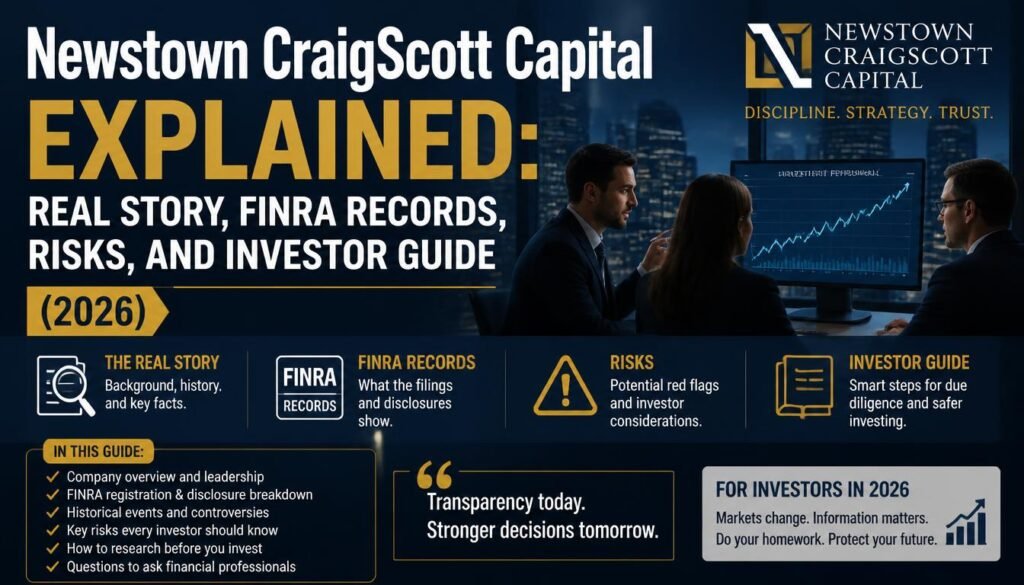
If you searched for Newstown CraigScott Capital, you may have noticed something confusing. Some online pages describe it like a modern wealth management firm offering advanced investment strategies, while others connect the name with old FINRA disciplinary records related to Craig Scott Capital, LLC.
This confusion has made many people wonder:
- Is Newstown CraigScott Capital a real investment company?
- Is it connected to Craig Scott Capital, LLC?
- Should investors trust this name?
- What do FINRA and SEC records actually show?
The short answer is simple: there is no official registration record for “Newstown CraigScott Capital” as a broker-dealer or investment adviser with FINRA or the SEC. The name appears to be connected to online content using a newer keyword variation around the history of the older brokerage firm, Craig Scott Capital, LLC.
Understanding the difference between online search results and official financial records is important before trusting any investment-related name.
Is Newstown CraigScott Capital a Real Financial Firm?
At the time of checking available regulatory information, there is no evidence that Newstown CraigScott Capital exists as a registered financial firm.
Legitimate investment companies in the United States normally appear in official databases such as:
- FINRA BrokerCheck
- SEC Investment Adviser Public Disclosure (IAPD)
- SEC registration records
- Regulatory filings
A company managing investments or operating as a broker-dealer should have:
- A legal business name
- Registration information
- CRD number
- Named executives
- Regulatory history
- Verifiable office information
The absence of these details is a major warning sign.
The name appears online because of its similarity to Craig Scott Capital, LLC, a former brokerage firm with a documented regulatory history.
The Connection Between Newstown CraigScott Capital and Craig Scott Capital, LLC
The real company connected to the name is Craig Scott Capital, LLC.
Craig Scott Capital was a boutique brokerage firm based in Uniondale, New York and registered under CRD #155924. The company offered brokerage services, active trading strategies, and portfolio management for retail clients.
The firm was led by:
- Craig Scott Taddonio – President and CEO
- Brent Morgan Porges – Chief Operating Officer
Unlike the newer “Newstown CraigScott Capital” name, Craig Scott Capital, LLC has a public regulatory history documented through FINRA records.
The appearance of “Newstown” seems to be related to online articles and search engine content rather than an officially registered company.
Why Is Newstown CraigScott Capital Appearing Online?
One reason this name has gained attention is the rise of programmatic SEO content and low-quality content networks.
Some websites publish articles designed mainly to capture search traffic. These pages often:
- Use trending keywords
- Create new variations of existing names
- Repeat similar descriptions
- Avoid providing official company details
- Lack registration numbers or executive information
In this case, many articles use phrases like:
- “modern wealth management”
- “data-driven investment strategy”
- “institutional-grade research”
However, marketing language does not prove that a company is legitimate.
A real financial firm must have regulatory verification.
Search visibility does not equal financial credibility.
The Real History of Craig Scott Capital, LLC
Founding and Business Operations
Craig Scott Capital, LLC operated as a brokerage firm serving retail investors. It focused on active trading strategies and personalized investment services.
However, regulatory concerns eventually led to investigations by FINRA.
The major issues involved:
- Excessive trading
- Customer account activity
- Commission generation
- Supervisory failures
- False statements to regulators
FINRA Investigation and Regulatory Problems
According to FINRA findings, Craig Scott Capital faced serious regulatory problems.
The timeline included:
2014
The firm was fined and censured $7,500 for inaccurate or incomplete execution reports.
2015
FINRA suspended the firm’s membership.
2016
FINRA filed an amended complaint involving allegations of:
- Churning
- Excessive trading
- Failure to supervise
2017
Craig Scott Capital, LLC was expelled from FINRA membership.
This meant the firm could no longer operate as a FINRA member broker-dealer.
What Is Churning in Investing?
One of the main issues connected with Craig Scott Capital was churning.
Churning happens when a broker performs excessive trades mainly to generate commissions rather than benefit the investor.
For example:
A broker may repeatedly buy and sell securities in a customer account. Each transaction creates fees and commissions, but the investor may suffer losses.
Regulators often examine:
- Turnover rate
- Cost-to-equity ratio
- Trading frequency
- Commission expenses
High trading activity does not automatically mean fraud, but unnecessary trading designed around commissions can harm investors.
Customer Losses and Commission Concerns
According to the FINRA complaint, brokers connected with Craig Scott Capital generated significant commission revenue while customers experienced losses.
Reported figures included:
- More than $5 million earned in commissions by the firm, owners, and brokers
- More than $9 million in customer losses during the same period
This situation highlights an important investor lesson:
A financial professional’s incentives should align with the client’s goals.
When compensation depends heavily on trading volume, conflicts of interest can develop.
False Statements and Failure to Supervise
FINRA also identified additional compliance concerns.
These included:
- False statements provided during regulatory requests
- Weak supervisory systems
- Failure to properly monitor trading activities
Financial firms are required to maintain compliance procedures that protect investors.
A strong compliance system helps detect:
- Suspicious trading
- Excessive commissions
- Account abuse
- Regulatory violations
What Happened After the FINRA Expulsion?
The expulsion of Craig Scott Capital did not end every regulatory matter.
Proceedings involving individuals connected with the firm continued through:
- FINRA hearing processes
- Appeals
- SEC review
Individuals associated with financial firms can have separate regulatory records from the company itself.
That is why investors should check both:
- The investment firm
- The individual broker or adviser
How to Verify Any Investment Firm Yourself
Before trusting any financial company, investors should perform basic due diligence.
Follow these steps:
1. Search FINRA BrokerCheck
FINRA BrokerCheck allows users to review:
- Broker registration
- Employment history
- Customer complaints
- Regulatory actions
- Disciplinary records
2. Check SEC Records
For investment advisers, review:
- SEC registration
- IAPD information
- Public filings
3. Verify the Legal Company Name
A company’s marketing name may not be its legal name.
Always confirm:
- Exact business name
- Registration number
- Regulatory status
4. Research Individual Executives
A clean-looking company name does not guarantee trustworthy leadership.
Check:
- CEO history
- Broker records
- Previous firms
- Regulatory disclosures
Red Flags When Someone Uses the Name Newstown CraigScott Capital
If someone contacts you using this name, watch for warning signs.
Common investment scam indicators include:
- No CRD number
- No FINRA registration
- Pressure to invest quickly
- Requests to send money personally
- Unclear regulatory information
- Promises of guaranteed returns
- Lack of physical office details
A professional investment firm should welcome questions about registration and compliance.
Important Investor Lessons From This Case
Registration Matters More Than Marketing
Words like:
- “Premium investment solutions”
- “Institutional research”
- “Advanced strategies”
sound impressive, but they do not prove legitimacy.
Only official registration records can confirm whether a company is authorised.
Old Regulatory Records Do Not Simply Disappear
A company may stop operating, but its regulatory history remains available.
Investors should understand that:
- Firms have histories
- Brokers have histories
- Executives have histories
Checking background information is a key part of financial due diligence.
Frequently Asked Questions
Is Newstown CraigScott Capital the same as Craig Scott Capital, LLC?
No official record confirms that they are the same legal entity. The newer name appears online through articles connecting it with the older firm’s history.
Can Craig Scott Capital return under a new name?
A firm expelled from FINRA cannot simply continue operating under a different name. However, individuals may appear in future financial roles depending on regulatory approval and disclosure requirements.
Is Newstown CraigScott Capital a confirmed scam?
There is no confirmed evidence that this exact name represents an active scam operation. However, the lack of registration and unclear identity means investors should be extremely cautious.
How can I check if an investment firm is legitimate?
Use official sources such as:
- FINRA BrokerCheck
- SEC databases
- Regulatory filings
- Public disclosure records
Final Thoughts: What Investors Should Remember
The story of Newstown CraigScott Capital shows an important lesson: online popularity does not equal financial legitimacy.
A name appearing in search results does not prove that a company exists, operates legally, or deserves your trust.
Before investing money, always verify:
- Registration status
- Regulatory history
- Company ownership
- Broker backgrounds
- Asset custody arrangements
Financial due diligence is one of the best protections investors have.
A professional-looking website or article can be created quickly, but official regulatory records provide the real picture.