
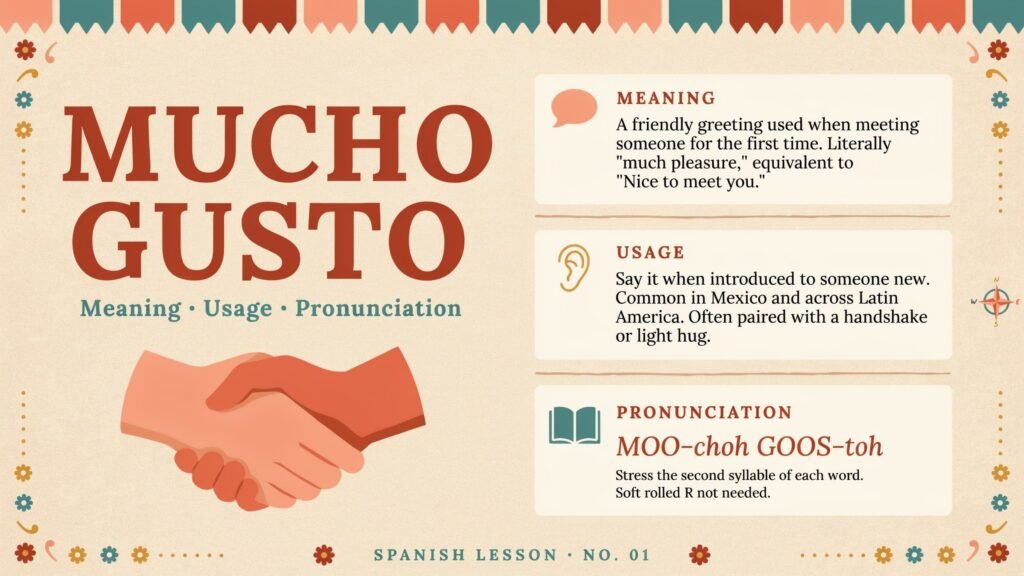
If you’ve just started learning Spanish, there’s a good chance “mucho gusto” was one of the first phrases you heard. It’s simple, polite, and used in everyday conversations across the Spanish-speaking world. But the mucho gusto meaning goes beyond a direct translation. It reflects respect, friendliness, and the importance of making a positive first impression.
Many English speakers translate it as “nice to meet you,” and while that’s correct, there’s a little more to the story. Understanding when to use it, how native speakers respond, and how it compares with other Spanish greetings will help you sound much more natural.
In this guide, you’ll learn the complete meaning of mucho gusto, its pronunciation, English translation, cultural significance, common responses, and practical examples you can use in real conversations.
What Does Mucho Gusto Mean?
The literal translation of mucho gusto is “much pleasure.” However, literal translations rarely sound natural in English.
Instead, the phrase is commonly translated as:
- Nice to meet you
- Pleased to meet you
- It’s a pleasure to meet you
Among these, “Nice to meet you” is by far the most common English equivalent.
Spanish often uses shorter expressions where English requires a complete sentence. Rather than saying, “It is a pleasure to meet you,” native Spanish speakers simply say mucho gusto, and everyone understands the intended meaning.
Breaking Down the Phrase
Understanding each word makes the expression easier to remember.
| Spanish Word | English Meaning | Part of Speech |
|---|---|---|
| Mucho | Much, a lot | Adjective |
| Gusto | Pleasure, liking, taste | Noun |
Together, they express the idea that meeting someone brings pleasure.
The phrase comes from the noun gusto, which is also connected to the verb gustar, meaning “to like.”
For example:
- Me gusta el café. (I like coffee.)
- Me gusta aprender español. (I like learning Spanish.)
Although these expressions share the same root, their meanings depend on the context.
Mucho Gusto Meaning in English
When translating Spanish into English, context matters more than word-for-word translation.
Here are the most natural English equivalents.
| Spanish | Natural English |
|---|---|
| Mucho gusto | Nice to meet you |
| Encantado | Delighted to meet you |
| Es un placer | It’s a pleasure |
| Un gusto | Nice meeting you |
Notice that no native English speaker says “Much pleasure.” That’s why direct translation isn’t always the best option.
Which Language Is Mucho Gusto?
Many beginners ask, “Mucho gusto belongs to which language?”
The answer is simple.
It comes from Spanish, one of the world’s most widely spoken languages with more than 500 million native speakers.
You’ll hear this expression throughout the Spanish-speaking world, including:
- Spain
- Mexico
- Colombia
- Argentina
- Peru
- Chile
- Ecuador
- Guatemala
- Costa Rica
- Dominican Republic
Although pronunciation and accent differ slightly from country to country, the phrase itself remains almost identical everywhere.
When Should You Say Mucho Gusto?
This is where many learners get confused.
Mucho gusto is generally used only when meeting someone for the first time.
Appropriate situations include:
- First introductions
- Business meetings
- Job interviews
- School orientations
- Academic conferences
- Professional networking
- Meeting friends of friends
- Meeting relatives for the first time
Once you’ve already met someone, you usually switch to greetings like:
- Hola
- Buenos días
- Buenas tardes
- ¿Cómo estás?
- ¿Qué tal?
Using mucho gusto every time you meet the same person would sound unusual.
Situations Where You Shouldn’t Use Mucho Gusto
Avoid using the phrase:
- As a goodbye
- When greeting someone you’ve already met
- During ongoing conversations
- In place of “thank you”
- While accepting a request
Those situations require different expressions.
Learning these small differences makes your Spanish sound far more natural.
Other Ways to Say Nice to Meet You in Spanish
Spanish offers several alternatives depending on the situation.
Encantado / Encantada
Meaning:
“Delighted.”
This expression changes according to gender.
Male speakers say:
Encantado
Female speakers say:
Encantada
Example:
María: Mucho gusto.
Carlos: Encantado.
Es un placer
This translates to:
“It’s a pleasure.”
It is slightly more formal and common in business settings.
Un gusto
A shorter version that’s widely used in Latin America.
Qué gusto conocerte
Meaning:
“What a pleasure to meet you.”
This version sounds friendly and slightly warmer than mucho gusto.
Encantado vs Mucho Gusto
One of the most common questions among Spanish learners is whether encantado or mucho gusto is better.
The answer depends on context.
| Phrase | Tone | Gender Changes |
|---|---|---|
| Mucho gusto | Neutral | No |
| Encantado | Warm | Yes |
| Encantada | Warm | Yes |
| Es un placer | Formal | No |
In professional settings, mucho gusto sounds polished and respectful.
Among friends or social gatherings, encantado often feels a little warmer.
Neither choice is wrong.
How Do You Respond to Mucho Gusto?
Knowing the response is just as important as knowing the greeting.
Here are the most common replies.
| Someone Says | Natural Reply |
|---|---|
| Mucho gusto | Igualmente |
| Mucho gusto | El gusto es mío |
| Encantado | Encantado |
| Mucho gusto | Mucho gusto |
Igualmente
Meaning:
“Likewise.”
This is probably the easiest and most common response.
El gusto es mío
Meaning:
“The pleasure is mine.”
It’s slightly more formal and very polite.
Repeat the Phrase
Sometimes people simply respond with:
“Mucho gusto.”
That’s completely acceptable too.
Conversation Examples
Business Meeting
Carlos:
Mucho gusto, señora Rodríguez.
Rodríguez:
Igualmente, señor Carlos.
University Introduction
Ana:
Hola, soy Ana.
David:
Mucho gusto.
Ana:
El gusto es mío.
Conference Networking
Miguel:
Mucho gusto, profesor.
Professor:
Encantado.
These examples show how naturally the phrase fits into everyday conversations.
Mucho Gusto Pronunciation
Correct pronunciation helps you sound more confident.
Phonetic pronunciation:
/ˈmu.tʃo ˈɡus.to/
Break it into smaller sounds.
- Mu = “moo”
- Cho = “cho”
- Gus = “goos”
- To = “toh”
Stress falls on:
MU-cho GUS-to
Spanish pronunciation is very consistent, so once you learn the sounds, you’ll pronounce many other words correctly too.
Common Pronunciation Mistakes
Many English speakers accidentally say:
- Moo-cho Goo-stow
- Moo-ko Gusto
- Moo-cho Guss-too
Instead, keep the vowels short and smooth.
Spanish pronunciation flows naturally without exaggerating the final vowels.
What Does Con Mucho Gusto Mean?
Many learners confuse mucho gusto with con mucho gusto.
Although they look similar, they have completely different meanings.
| Phrase | Meaning |
|---|---|
| Mucho gusto | Nice to meet you |
| Con mucho gusto | With pleasure |
Example:
¿Puedes ayudarme?
Con mucho gusto.
English:
Can you help me?
With pleasure.
Notice that con mucho gusto is used when happily accepting a request, not during introductions.
Gusto Meaning in Spanish
The word gusto has several meanings depending on context.
It may refer to:
- Pleasure
- Taste
- Preference
- Enjoyment
- Liking
Examples:
Me gusta la música.
(I like music.)
Da gusto verte.
(It’s nice to see you.)
Tengo buen gusto.
(I have good taste.)
Understanding the root word makes it easier to recognise similar Spanish expressions.
Cultural Importance of Mucho Gusto
Language is closely connected to culture.
Across many Spanish-speaking countries, introductions matter.
Greeting someone politely helps establish trust before the actual conversation begins.
Especially in professional environments, people often appreciate respectful introductions more than rushing directly into business.
A simple mucho gusto communicates:
- Respect
- Friendliness
- Professionalism
- Positive intentions
- Good manners
These small details can leave a lasting first impression.
Spain vs Latin America
Although the phrase is understood everywhere, its use varies slightly.
Spain
People often speak more directly.
You may hear:
- Encantado
- Encantada
- Mucho gusto
Young people sometimes skip formal greetings altogether in casual situations.
Latin America
Politeness is often emphasised more strongly.
You’ll frequently hear:
- Mucho gusto
- Es un placer
- Encantado
- Señor
- Señora
Titles are commonly used in professional conversations.
That added formality helps show respect.
Business Spanish Etiquette
If you’re attending a business meeting in a Spanish-speaking country, introductions matter.
A good first impression usually includes:
- Eye contact
- A firm handshake
- A friendly smile
- Professional titles
- Saying “Mucho gusto”
In many Latin American countries, hierarchy is valued more than in casual English-speaking workplaces.
Simple gestures of respect can strengthen professional relationships.
Common Mistakes Learners Make
Here are mistakes worth avoiding.
- Using mucho gusto every time you see someone.
- Confusing mucho gusto with con mucho gusto.
- Forgetting gender when saying encantado or encantada.
- Mixing tú and usted in formal conversations.
- Pronouncing Spanish words with English vowel sounds.
Fortunately, these mistakes become less common with regular practice.
Why Translation Isn’t Always Perfect
Language is more than vocabulary.
The phrase mucho gusto literally means “much pleasure,” yet nobody would naturally say that in English.
Instead, translators focus on conveying the intended meaning rather than individual words.
That’s why nice to meet you is considered the best translation.
Understanding this principle will help you learn many other Spanish expressions more naturally rather than translating every word individually.