
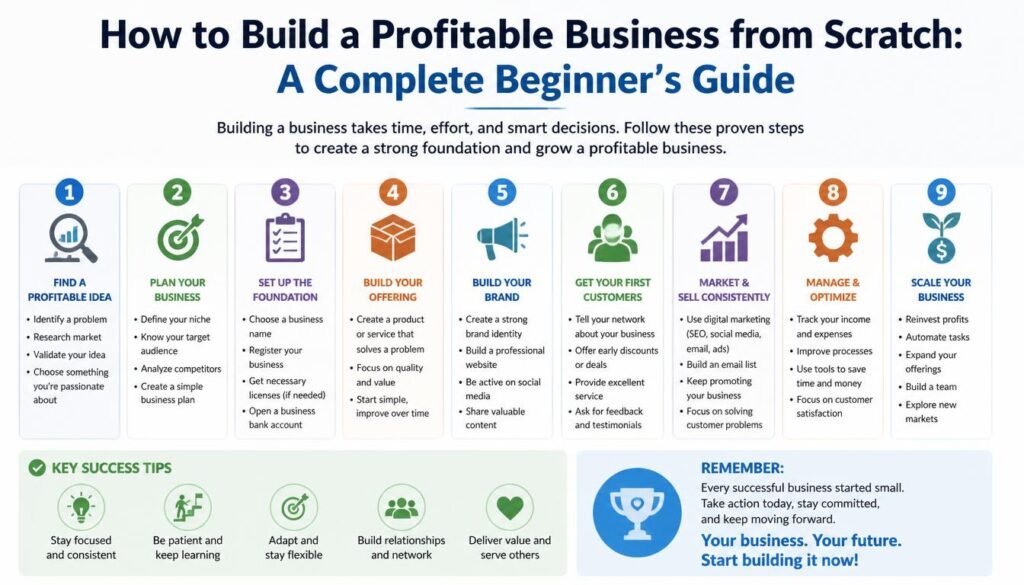
Starting a business is one of the best ways to achieve financial freedom and build long-term wealth. However, turning a simple idea into a profitable business takes more than passion. It requires careful planning, market research, smart financial decisions, and a commitment to solving real customer problems.
Many successful entrepreneurs did not become profitable overnight. They started with a clear business idea, validated their market, built a strong business model, and continuously improved their products and services. Whether you want to launch a small business, an online startup, or transform your side hustle into a full-time company, following the right strategy can significantly increase your chances of success.
This guide explains how to build a profitable business from scratch using proven methods that are easy to understand and implement. You’ll learn about choosing the right business idea, conducting market research, creating a business plan, building a recognizable brand, attracting customers, increasing sales, and scaling your business sustainably.
Choose the Right Business Idea
Every successful startup begins with a great business idea. The best ideas solve real problems and provide value to customers. Instead of creating a product simply because you like it, focus on what people actually need.
Before investing your time and money, ask yourself:
- Does this business solve a real customer problem?
- Is there enough market demand?
- Who are my competitors?
- Can this business generate consistent revenue?
- What makes my business different?
The most profitable businesses focus on providing practical solutions rather than just selling products.
For example, many entrepreneurs noticed that busy professionals struggled to cook healthy meals. Instead of opening a traditional restaurant, they launched meal-prep subscription services that offered convenience and recurring revenue.
Practical Tip
Write down at least ten business ideas. Compare each one based on customer demand, competition, startup costs, and your personal skills. Choose the idea with the strongest long-term potential.
Conduct Thorough Market Research
Many startups fail because they skip market research. Understanding your target audience before launching helps reduce risks and improve your chances of success.
Market research allows you to learn:
- Customer demographics
- Buying behavior
- Industry trends
- Pricing strategies
- Competitor strengths and weaknesses
- Customer pain points
- Market size
- Growth opportunities
You can collect valuable information using:
- Online surveys
- Customer interviews
- Google search trends
- Keyword research tools
- Competitor websites
- Social media discussions
- Online reviews
The more you understand your audience, the easier it becomes to develop products people actually want.
Real-World Example
A small fitness startup originally planned to sell expensive yearly memberships. After interviewing potential customers, they discovered most people preferred affordable monthly subscriptions. By adjusting their business model, they increased customer acquisition and recurring revenue.
Create a Detailed Business Plan
A well-written business plan acts as the roadmap for your startup. It helps you stay organized, attract investors, and make better business decisions.
Your business plan should include:
Executive Summary
Explain your business concept, goals, and mission.
Business Objectives
Define short-term and long-term goals that are measurable.
Target Market
Describe your ideal customers, including age, location, income, and interests.
Products or Services
Explain how your products solve customer problems and what makes them unique.
Revenue Model
Identify how your business will make money.
Examples include:
- Product sales
- Subscription services
- Memberships
- Consulting
- Advertising
- Affiliate marketing
Marketing Strategy
Outline how you will attract customers using SEO, content marketing, email marketing, social media marketing, referral programs, and paid advertising.
Financial Projections
Estimate:
- Startup costs
- Monthly expenses
- Expected revenue
- Profit margins
- Cash flow
- Break-even point
A detailed business plan makes it easier to secure funding and monitor progress.
Complete the Legal Setup
Every business should complete its legal requirements before serving customers.
Depending on your country, this may include:
- Registering your business
- Choosing a legal business structure
- Obtaining business licenses
- Registering for taxes
- Opening a business bank account
- Protecting trademarks
- Securing intellectual property
Legal compliance protects your business, improves customer trust, and reduces future risks.
Many entrepreneurs ignore legal paperwork until problems arise. Completing these steps early saves time and money later.
Build a Strong Brand Identity
A strong brand identity helps customers recognize, trust, and remember your business.
Branding is much more than designing a logo. It represents the overall experience customers have with your company.
Your brand should include:
- A memorable business name
- Professional logo
- Brand colors
- Typography
- Brand voice
- Mission statement
- Company values
Consistency across your website, packaging, email campaigns, and social media creates stronger brand recognition.
Customers often choose brands they trust, even when competitors offer similar products.
Ask yourself:
- What does my business stand for?
- How do I want customers to feel?
- What makes my brand unique?
Strong branding builds credibility and increases customer loyalty.
Secure Funding Wisely
Most businesses need startup capital to purchase equipment, develop products, build websites, hire employees, or launch marketing campaigns.
Common funding sources include:
- Personal savings
- Small business loans
- Angel investors
- Venture capital
- Crowdfunding
- Government grants
- Friends and family investments
Avoid borrowing more money than necessary. Focus on maintaining positive cash flow, controlling expenses, and investing only in activities that generate measurable returns.
Successful entrepreneurs carefully monitor every dollar during the early stages of business.
Develop an Effective Marketing Strategy
Even the best product cannot succeed if people do not know it exists. A well-planned marketing strategy helps your business reach the right audience, generate leads, and increase sales. Instead of relying on one marketing channel, use a combination of digital marketing methods to build long-term growth.
Some of the most effective marketing channels include:
- Search Engine Optimization (SEO)
- Content marketing
- Social media marketing
- Email marketing
- Paid advertising (Google Ads and social media ads)
- Referral programs
- Influencer partnerships
- Video marketing
Each channel works differently, but together they create a strong online presence and improve brand awareness.
Invest in SEO
Search Engine Optimization (SEO) is one of the most cost-effective ways to attract customers. When your website ranks higher on search engines, you receive more organic traffic without paying for every visitor.
To improve your SEO:
- Research keywords your audience searches for.
- Create helpful and informative content.
- Use your primary keyword naturally in headings and paragraphs.
- Optimize title tags and meta descriptions.
- Improve page loading speed.
- Make your website mobile-friendly.
- Build high-quality backlinks.
- Update old content regularly.
SEO is a long-term strategy, but it can deliver consistent traffic and qualified leads for years.
Create Valuable Content
Content marketing helps establish your business as an expert in your industry. Instead of only promoting products, answer your customers’ questions through useful content.
Examples include:
- Blog posts
- How-to guides
- Tutorials
- Videos
- Case studies
- Infographics
- FAQs
- Checklists
Educational content builds trust, improves search engine rankings, and encourages visitors to return to your website.
Practical Tip
Publish new, high-quality content consistently. One helpful article each week can significantly improve your website’s visibility over time.
Focus on Sales and Customer Experience
Getting visitors to your website is only the first step. Turning those visitors into paying customers requires an effective sales process and an excellent customer experience.
Customers are more likely to buy when the purchasing process is simple and trustworthy.
Improve your sales process by:
- Offering transparent pricing
- Writing persuasive product descriptions
- Using high-quality product images
- Simplifying the checkout process
- Responding quickly to customer inquiries
- Providing multiple payment options
- Following up after purchases
A smooth buying experience increases your conversion rate and encourages repeat purchases.
Build Customer Trust
People buy from businesses they trust. You can build credibility by:
- Displaying customer reviews
- Publishing testimonials
- Showing trust badges
- Providing secure payment methods
- Offering money-back guarantees
- Sharing your business story
- Maintaining transparent policies
Trust plays a major role in customer acquisition and long-term business success.
Prioritize Customer Retention
Many businesses focus only on attracting new customers. However, retaining existing customers is usually more profitable than constantly finding new ones.
Loyal customers:
- Spend more money
- Buy more frequently
- Recommend your business
- Leave positive reviews
- Increase customer lifetime value
Ways to improve customer retention include:
- Deliver excellent customer support
- Offer loyalty rewards
- Personalize email communication
- Ask for customer feedback
- Resolve complaints quickly
- Launch exclusive offers for returning customers
Building long-term relationships creates sustainable revenue and strengthens your business reputation.
Example
A local coffee shop introduced a digital loyalty card that rewarded customers with a free drink after ten purchases. Within six months, repeat customer visits increased significantly, boosting monthly revenue.
Monitor Your Financial Performance
Profitability depends on more than making sales. You also need to manage expenses and monitor financial performance regularly.
Track important business metrics such as:
- Revenue
- Expenses
- Profit margin
- Cash flow
- Customer acquisition cost (CAC)
- Customer lifetime value (CLV)
- Return on Investment (ROI)
- Monthly recurring revenue (MRR)
Using accounting software or financial dashboards helps you understand your business performance and make informed decisions.
Businesses that regularly review financial reports are more likely to identify problems before they become serious.
Scale Your Business Strategically
Once your business becomes consistently profitable, you can begin scaling your operations.
Scaling means increasing revenue without increasing costs at the same rate.
Effective growth strategies include:
Expand Your Product Line
Introduce complementary products or services that meet additional customer needs.
Enter New Markets
Expand into different cities, regions, or international markets if demand exists.
Hire Skilled Employees
As your workload grows, hiring experienced team members allows you to focus on strategy instead of daily operations.
Automate Repetitive Tasks
Automation tools improve productivity by handling repetitive work such as:
- Email marketing
- Customer support
- Inventory management
- Accounting
- Appointment scheduling
Automation reduces costs while improving efficiency.
Invest in Technology
Modern business software can improve operations by streamlining communication, project management, customer relationship management (CRM), and financial reporting.
Technology enables businesses to scale faster while maintaining high-quality customer service.
Common Mistakes to Avoid
Many startups fail because they repeat the same avoidable mistakes.
Here are some of the most common business mistakes:
- Skipping market research
- Ignoring customer feedback
- Choosing the wrong target audience
- Poor financial planning
- Overspending during the startup phase
- Weak branding
- Neglecting SEO and digital marketing
- Trying to grow too quickly
- Failing to monitor cash flow
- Ignoring competitors
- Inconsistent customer service
- Lack of clear business goals
Learning from these mistakes can save both time and money.
Practical Tips for Building a Profitable Business
Follow these proven strategies to increase your chances of long-term success:
- Solve real customer problems instead of chasing trends.
- Validate your business idea before investing heavily.
- Build a strong and memorable brand identity.
- Understand your target audience thoroughly.
- Conduct regular competitor analysis.
- Monitor cash flow every month.
- Invest consistently in SEO and content marketing.
- Focus on customer satisfaction.
- Build long-term customer relationships.
- Continuously improve your products and services.
- Stay updated with industry trends.
- Use technology to improve productivity.
- Measure business performance regularly.
- Adapt quickly to changing market conditions.
- Never stop learning and improving.
Successful entrepreneurs understand that continuous improvement is the key to sustainable business growth.
Conclusion
Building a profitable business from scratch is a journey that requires planning, patience, and persistence. Success rarely happens overnight, but businesses that focus on solving real customer problems, conducting thorough market research, creating a detailed business plan, and building a strong brand are much more likely to achieve long-term profitability.
A successful business also invests in digital marketing, SEO, customer acquisition, and customer retention while carefully managing cash flow and operational efficiency. By consistently delivering value, monitoring financial performance, and adapting to market changes, you can create a resilient business that continues to grow year after year.
Remember, every successful company started with a simple idea. The difference between businesses that fail and those that thrive is consistent execution, informed decision-making, and a commitment to serving customers better than the competition.
Frequently Asked Questions (FAQs)
1. What is the first step in building a profitable business?
The first step is identifying a business idea that solves a real customer problem. Validate the idea through market research before investing significant time or money.
2. Why is market research important?
Market research helps you understand customer needs, analyze competitors, identify market demand, develop effective pricing strategies, and reduce business risks.
3. How much funding do I need to start a business?
Funding depends on your business model, industry, and startup costs. Begin with a realistic budget and seek external funding only when necessary.
4. How can I attract customers to a new business?
Use a combination of SEO, content marketing, social media marketing, email marketing, referral programs, paid advertising, and excellent customer service to attract and retain customers.
5. When should I scale my business?
Scale your business only after achieving consistent profitability, maintaining positive cash flow, building efficient operations, and ensuring high customer satisfaction.
6. How long does it take for a business to become profitable?
The timeline varies depending on the industry, competition, and business model. Some businesses become profitable within months, while others may take several years. Consistent planning, smart financial management, and effective marketing can shorten the path to profitability.
7. Is SEO important for a new business?
Yes. SEO helps your business rank higher in search engine results, attract organic traffic, build brand authority, and generate long-term leads without relying solely on paid advertising. A strong SEO strategy is essential for sustainable online business growth.