
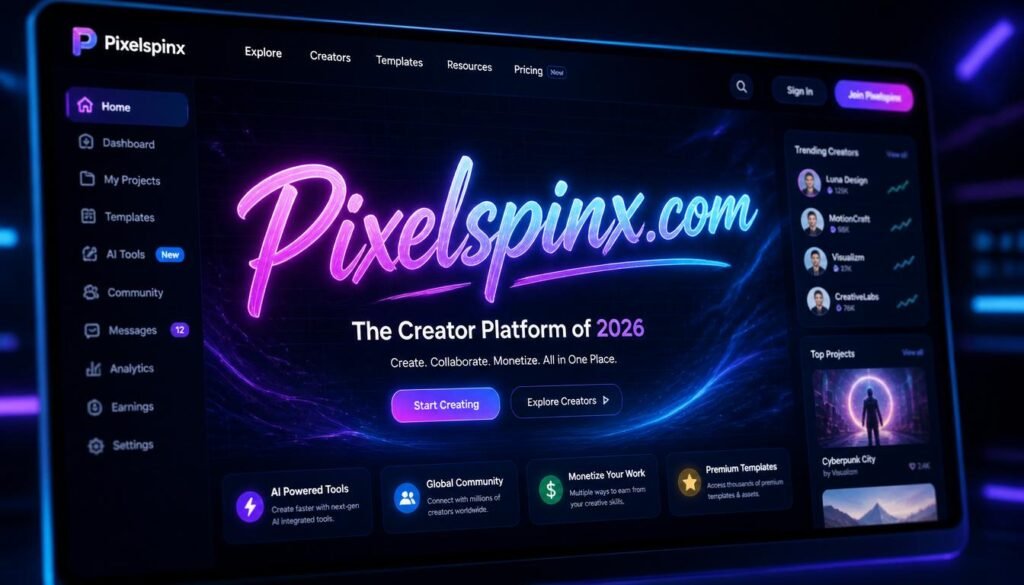
If you’ve been anywhere near blogging forums or creator Discord servers this year, you’ve probably run into the name pixelspinx.com. It shows up in half a dozen near-identical explainer posts, all published within the last couple months, all describing it the same vague way: a “creator-focused publishing and monetization hub.” Sounds promising. Except when you actually try to dig into who runs it, what it looks like, or whether real people are using it, the trail goes cold pretty fast.
That’s worth sitting with for a second before we go further, because it changes how this article needs to be written.
The Honest Starting Point
I looked into pixelspinx.com directly before writing this. What I found wasn’t a platform with a homepage, a pricing page, a founder bio, or a single verifiable user testimonial. What I found was a cluster of SEO articles, all structurally similar, all published around May and June 2026, all using the same hedged language: the platform “appears to” support this, it “seems designed” for that, it “positions itself as” the other thing. None of them link to a working product. None cite a company registration, a funding round, or a single named person behind it.
That pattern is a known one in content marketing circles. It’s what happens when a domain gets registered, possibly for a future product, possibly just to squat on a plausible-sounding name, and a wave of AI-assisted articles get published to rank for the search term before there’s anything real to describe. It doesn’t necessarily mean pixelspinx.com is a scam. It might genuinely launch into something real down the line. But right now, treating it as an established creator platform with a comparison-ready feature set would be misleading you.
So instead of inventing details pixelspinx.com hasn’t actually published anywhere, let’s use this as a chance to talk about what a serious 2026 creator platform actually needs to offer, and how you’d vet one before investing your time in it.
Why the Term Is Trending Anyway
The interest in a name like this isn’t random. It’s riding a real wave.
Creators spent the better half of the last decade building audiences on rented land. A Facebook page, an Instagram following, a YouTube channel, none of it actually belongs to the person who built it. One algorithm change, one policy shift, one account suspension, and years of work can vanish or go dark overnight. That fear is not hypothetical; creators have watched it happen to peers, sometimes to themselves.
By 2026, the response to that fear has a name: the ownership economy. Writers and educators want:
- Direct access to their subscriber list, not a platform-mediated one
- Monetization that doesn’t depend on ad rates or brand deals
- Content that keeps earning through search traffic long after it’s published
- A brand identity that isn’t buried inside someone else’s template
Substack proved newsletters could carry a business. Patreon proved memberships could fund creative work without ads. Gumroad and Ko-fi proved you didn’t need a huge audience to sell something small and useful. Ghost proved you could run all of it on infrastructure you actually control. Every new platform name that surfaces, pixelspinx.com included, gets read against that backdrop, because the appetite for “the next one” is genuinely strong right now.
What “Creator-First” Actually Requires
Since pixelspinx.com hasn’t published verifiable specifics, it’s more useful here to lay out the bar that any legitimate 2026 creator platform has to clear, so you can measure it (or anything else you’re considering) against something real.
| Requirement | Why it matters |
|---|---|
| Audience portability | Can you export your subscriber list if you leave? |
| Transparent monetization cut | What percentage does the platform take, and when do you get paid? |
| SEO-accessible content | Are your articles indexable, or trapped behind a login wall? |
| Real company transparency | Is there a named team, a support contact, a registered business? |
| Data security practices | Two-factor authentication, encrypted storage, clear privacy policy |
| Track record | Uptime history, existing case studies, actual creator testimonials |
Notice that last row. Track record is the one thing marketing copy can’t fake convincingly for long. A platform that’s actually serving creators will have creators talking about it unprompted, on their own accounts, with specifics: screenshots, revenue numbers, gripes about a clunky editor, whatever. When every mention of a platform online originates from the same explainer-article template, that’s a signal to wait, not to sign up.
How to Vet Any New Creator Platform (Including This One)
Before you put real content or real audience trust into something new, a few checks take less than fifteen minutes and tell you a lot.
Check the domain’s registration age. Tools like WHOIS lookups will tell you when a site was actually registered, which tells you whether “the platform of 2026” has existed for six years or six weeks.
Look for the company behind it. A real platform, even an early-stage one, usually has a registered business entity, a LinkedIn presence for its founders, or at minimum a support email that isn’t a generic Gmail address.
Search for user complaints, not just praise. Reddit and independent forums are where creators actually vent about broken payout systems or disappearing content. If none of that exists either way, positive or negative, the platform likely doesn’t have real usage yet.
Ask what happens to your content and your list if the platform shuts down tomorrow. If there’s no clear answer, that’s your answer.
Test it before committing anything valuable. Publish something low-stakes first. See if payments, if any, actually process. See if support replies to a real question.
Where This Leaves Pixelspinx.com Specifically
At the time of writing, in July 2026, pixelspinx.com doesn’t have the kind of independently verifiable footprint that would let anyone responsibly describe its interface, pricing, monetization split, or feature set as fact. What exists is a name attached to a wave of similarly worded articles, and that’s genuinely all that can be said with confidence right now.
If you’re a creator who came across this name because you’re actually evaluating where to publish next, the more productive move is to compare established, verifiable options, Substack for newsletter-first work, Ghost if you want full ownership of your infrastructure, Patreon or Ko-fi for membership-driven income, Gumroad for one-off digital products, against your actual priorities: audience size, content format, how hands-on you want to be with the tech side, and how much of a cut you’re comfortable giving up.
None of that requires betting on a platform that hasn’t shown its work yet.
The Bigger Picture
The creator economy in 2026 is genuinely shifting toward ownership, and that shift is real even where individual platform names attached to it aren’t yet substantiated. Search-driven, evergreen content still compounds in value in a way viral social posts don’t. Diversified income, memberships plus products plus search traffic plus email, still beats depending on one channel. Those trends are worth building a strategy around regardless of which specific tool ends up being your home base.
Just build that strategy on platforms you can verify, not on the strength of an explainer article’s confident tone alone. If pixelspinx.com turns into something concrete, with a real product, real users, and real numbers to look at, that’s worth revisiting. Until then, the honest answer to “what is pixelspinx.com” is: not enough is publicly known yet to say.